
I would like to share a clinical story with you to demonstrate how intravenous NAD+ helps our patients. A 52-year-old executive sat in my office last spring and described a pattern I hear several times a month. He was sharp until about two in the afternoon, and then his thinking slowed, his recall got worse, and he spent the rest of the day pushing through fog. His labs were normal. His MRI was normal. He had read about NAD+ drips on a longevity podcast and wanted to know whether the science was real and worthy of his investment.
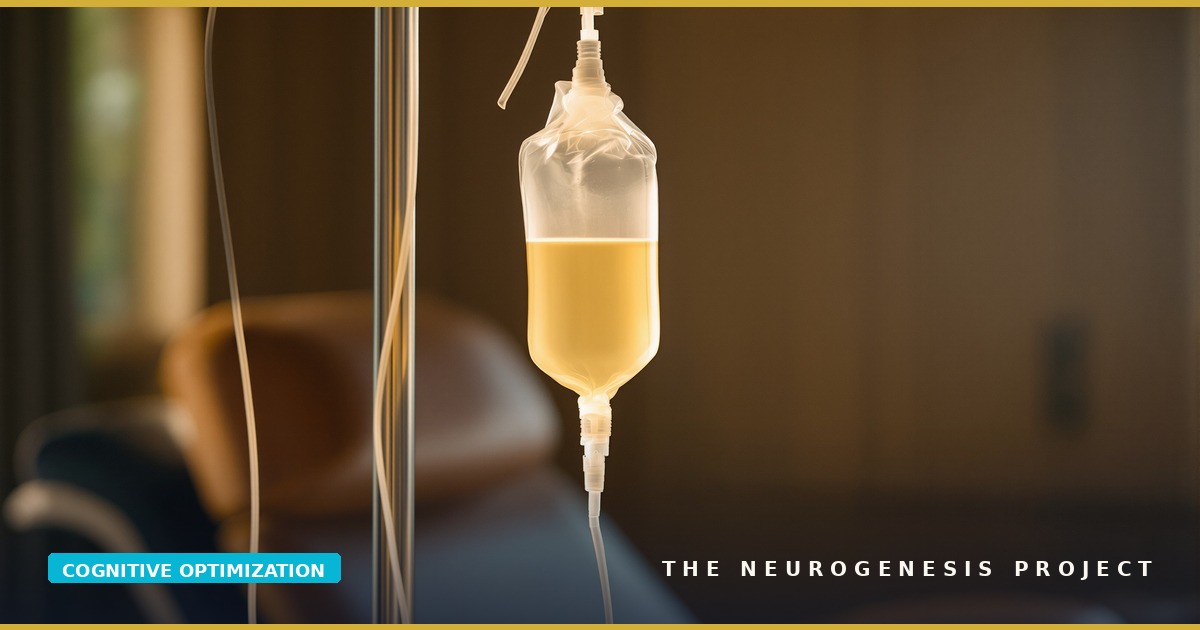
NAD+ IV therapy is the intravenous infusion of nicotinamide adenine dinucleotide, a coenzyme that every cell in the body uses to convert food into usable energy, repair DNA, and regulate the enzymes that govern cellular aging. Levels of NAD+ fall with age, and the brain, which uses about 20 percent of the body's energy while making up about 2 percent of its weight, is the organ most exposed to that decline. An infusion delivers a measured dose of NAD+ directly into the bloodstream over two to four hours, under clinical supervision, with the goal of restoring the raw material that neurons need for energy production and repair. That is the short answer. The longer answer, including what the evidence does and does not support, is the rest of this article.
What NAD+ does in the brain
To get to the point, NAD+ fuels the brain cells for action and repairs ones that are damaged, so the brain performs better overall. Inside a neuron, the mitochondria take glucose and oxygen and produce adenosine triphosphate, or ATP, the molecule that powers everything the cell does. NAD+ is the electron carrier that makes that process run. It picks up electrons during the breakdown of glucose, becomes NADH, hands those electrons to the electron transport chain, and cycles back to NAD+ to do it again. Without enough NAD+, the mitochondria cannot complete the cycle, and the cell's ATP supply falls.
The brain is unusually sensitive to that supply because neurons never rest. They spend ATP continuously to maintain the electrical gradients across their membranes, to manufacture and recycle neurotransmitters, and to keep synapses firing. A neuron that is short on ATP does not die immediately. It becomes sluggish, less able to fire on demand, and less able to clear the metabolic waste that accumulates during the day. In the exam room, that tends to look like slower recall, trouble sustaining attention, and fatigue that gets worse as the afternoon goes on. That is my executive's two o'clock slump described at the level of the cell.
NAD+ has a second job that matters as much as the first. It is the substrate for two families of enzymes that maintain the cell over the long term. The sirtuins regulate mitochondrial biogenesis, inflammatory signaling, and the cell's response to stress, and they cannot function without NAD+ available. The PARP enzymes detect and repair single-strand breaks in DNA, and each repair consumes NAD+. When NAD+ is scarce, the cell has to ration it between making energy and making repairs, and both suffer.
Why NAD+ levels fall with age
For a long time the decline in NAD+ with age was inferred from animal tissue. In 2015, a group at the University of Minnesota led by Xiao-Hong Zhu measured it directly in living human brains. Using phosphorus magnetic resonance spectroscopy at 7 tesla, they imaged the occipital lobes of 17 healthy adults between 21 and 68 years old and found that brain NAD+ concentration correlated inversely with age (r = -0.75), while NADH rose. The ratio between the two, which reflects how much oxidizing capacity the tissue has in reserve, fell in a nearly linear line across the decades. The paper was published in the Proceedings of the National Academy of Sciences, and it is the clearest human evidence we have that the aging brain runs on a lower NAD+ budget than the young one.
The reason appears to be destruction rather than reduced production. In 2016, Eduardo Chini's group at Mayo Clinic reported in Cell Metabolism that an enzyme called CD38, which degrades NAD+, increases two- to threefold with age in every mouse tissue they tested, and up to 2.5-fold in the fat tissue of adults around 61 compared with adults around 34. CD38 sits on inflammatory cells, so the more low-grade inflammation a person carries, the faster the enzyme consumes the NAD+ pool. Chronic inflammation, poor sleep, alcohol, and metabolic disease all tend to push that process along. At 52, with a travel schedule, short nights, and a few glasses of wine most evenings, my executive was sitting squarely in the window where this decline becomes noticeable.
How NAD+ IV therapy works, and what happens to the NAD+ you infuse
The appeal of the IV route is straightforward. Oral NAD+ is broken down in the gut before it is absorbed, so what reaches the blood is nicotinamide and its relatives, not intact NAD+. An infusion puts the molecule into the bloodstream intact and at full concentration. This makes the IV route the most efficient and effective way of refilling the NAD+ bucket.
NAD+ is a large, charged molecule, and it does not pass easily across cell membranes on its own. The only peer-reviewed time-course study of plasma NAD+ during an infusion, a pilot by Ross Grant and colleagues at the University of New South Wales published in Frontiers in Aging Neuroscience in 2019, infused 750 mg of NAD+ over six hours into eight healthy men and saline into three controls. For the first two hours, plasma NAD+ did not rise at all. The infused NAD+ was being cleared from the blood as fast as it arrived. Only after the second hour did plasma levels climb, reaching roughly five times baseline (a 398 percent increase) at the six-hour mark, when the infusion ended, and the urine showed a rise in NAD+ itself and in methylnicotinamide, a downstream metabolite.
The most plausible interpretation is that the infused NAD+ is being taken up and processed by tissues very quickly, in part through enzymes on the cell surface, including CD38, CD203a and CD73, that break it into nicotinamide, nicotinamide mononucleotide and nicotinamide riboside. Those smaller fragments can enter cells, where the cell rebuilds NAD+ from them. In other words, an NAD+ infusion appears to work largely by flooding the body with the building blocks of NAD+ and letting the cells do the assembly. That is a real mechanism, and it explains why the infusion rate matters so much. Deliver the molecule faster than the tissues can process it and the plasma concentration spikes, which is the most likely explanation for why patients feel unwell.
A building legacy of evidence
I tell every patient the same thing before their first infusion: the evidence for NAD+ as a target is strong, and the evidence for intravenous NAD+ as a treatment is still building on about four decades of research. Those are two different claims, and conflating them is how the field has been oversold.
The strongest human trials have used oral precursors rather than IV NAD+. In 2018, Christopher Martens and colleagues at the University of Colorado Boulder published a randomized, double-blind, placebo-controlled crossover trial in Nature Communications in which 30 healthy adults aged 55 to 79 took 1,000 mg of nicotinamide riboside daily for six weeks, crossed over with placebo. The supplement was well tolerated and raised NAD+ in blood cells by about 60 percent, with a signal toward lower blood pressure and arterial stiffness that the authors flagged for future trials. In 2022, the NADPARK study from the University of Bergen, published in Cell Metabolism, gave 1,000 mg of nicotinamide riboside daily or placebo for 30 days to 30 newly diagnosed Parkinson's patients. Brain NAD rose on magnetic resonance spectroscopy in the treated group, the rise was variable from patient to patient, and the patients whose brain NAD+ rose the most showed changes in cerebral metabolism on PET imaging alongside mild clinical improvement. That is the first randomized evidence that raising NAD+ changes brain chemistry in a neurological disease.
For intravenous NAD+ specifically, the published record consists of safety and tolerability studies rather than efficacy trials. The Grant pilot found no adverse events across the six-hour infusion and only minor, clinically insignificant shifts in liver enzymes. A 2026 retrospective study in Frontiers in Aging reviewed the records of patients who received 500 mg of IV NAD+ or IV nicotinamide riboside on four consecutive days in a commercial clinic. Liver, kidney, thyroid, and inflammatory markers showed no clinically meaningful change over 30 days of follow-up in either group (six NAD+ patients and eight NR patients, so a small series), and all infusion symptoms resolved when the drip ended. Neither study measured cognition, and neither was designed to.
The addiction setting deserves its own sentence. NAD+ infusions have been used in detoxification protocols for decades, and there is a coherent biological argument for them, since alcohol and stimulant use deplete NAD+ and impair the mitochondria that depend on it. There are no randomized controlled trials showing that IV NAD+ improves withdrawal or relapse rates. When I use it in that setting, I say so, and I use it alongside the medical and behavioral treatments that do have trial evidence behind them. However, our clinical experience to date has been extremely positive. Our patients who receive NAD+ alongside conventional detox find the whole process so much easier to tolerate, with fewer cravings, vasomotor symptoms, or mood instability.
What this means for the executive in my office is that an NAD+ infusion is a reasonable, low-risk intervention with a sound mechanism, early human safety data, and no large trial yet proving it improves afternoon cognition. We offer it as part of a workup that also measures the things that cause afternoon cognitive decline in the first place, including sleep apnea, insulin resistance, thyroid function, and inflammatory markers, because an infusion cannot fix a problem it was never measuring. If you want to see how we structure that evaluation, our IV infusion packages and the Intensive Brain Health Program describe the two ways patients work with us.
What an NAD+ infusion feels like
The infusion itself is uneventful for most people, and if flushing symptoms occur the cause is almost always the infusion rate, which is easily modified to improve comfort. The characteristic symptoms of NAD+ running too fast are a sense of pressure or tightness in the chest, nausea, vomiting or abdominal cramping, a racing heart, and, in my experience, flushing and restlessness. In the 2026 Frontiers in Aging series, the gastrointestinal symptoms, the increased heart rate and the chest pressure were what prolonged NAD+ infusions to a mean of 97 minutes compared with 37 minutes for nicotinamide riboside, and they went away as soon as the infusion was slowed or stopped. None of these symptoms indicate harm, and none persisted after the session, but they are unpleasant enough that a clinic should warn you about them and should have a nurse watching the drip rate, not a timer.
At The Neurogenesis Project, a 500 mg infusion runs for two to four hours depending on how the patient tolerates it. We start slowly, increase the rate as the first hour goes well, and slow it back down if the chest pressure appears. Patients read, work on a laptop, or sleep. My executive answered email through the first hour of his first infusion and dozed through the second. Most describe a mild sense of alertness during the second half of the infusion and a steadier, less jagged level of energy over the following days. Some describe nothing at all for the first session and more for the second or third, which is consistent with a mechanism that depends on the cells rebuilding their NAD+ pools rather than on the molecule acting like a stimulant.
Side effects, and who should not get NAD+ IV therapy
Beyond the rate-related symptoms during the infusion, side effects are uncommon. Headache and fatigue on the day of the infusion occur in some patients. Bruising at the IV site is the most common complaint and resolves on its own. The published safety data, both the Grant pilot and the 2026 series, found no meaningful changes in liver, kidney, or thyroid markers over the follow-up periods they measured.
Who should not receive it is a question of missing data more than known harm. There are no safety studies in pregnancy or breastfeeding, so we do not infuse NAD+ in either. Patients with advanced kidney or liver disease, unstable heart rhythms, or active cancer treatment need an individual conversation about whether an infusion makes sense and at what dose, because the pharmacokinetic data were gathered in healthy adults and do not tell us how a sick liver or kidney handles the load. Patients on multiple medications should have those reviewed, although NAD+ has no well-documented drug interactions. A clinic that infuses NAD+ without taking a medical history and reviewing a recent set of labs is skipping the part of the process that makes it safe.
NAD+ IV versus NMN and NR supplements
This is the question I am asked most often, and the honest answer is that both routes have a case. The oral precursors, nicotinamide riboside and nicotinamide mononucleotide, have the better trial record for raising NAD+ in blood and, in NADPARK, in brain tissue. They are inexpensive, they are taken daily, and they work through the same cellular assembly line that an infusion ultimately depends on.
The infusion has three advantages. The dose is large and delivered in one sitting, which matters when a patient is starting from a depleted state, as in early recovery from alcohol or after a concussion. The dose is verifiable, since the 503B facility's certificate of analysis tells us exactly what is in the bag, which is more than can be said for many over-the-counter NAD+ products. And the patient is observed, so tolerability and response can be documented rather than guessed at. One detail that trips up comparisons is that milligrams are not interchangeable across these molecules. NAD+ has a molecular weight of about 663, and nicotinamide riboside about 255, so 500 mg of NR contains more than twice the molar quantity of 500 mg of NAD+. A patient comparing an infusion to a supplement by the number on the label is comparing different things.
In practice I use both. Patients who do well with an initial series of infusions usually continue on an oral precursor between sessions, and patients who cannot travel for infusions start on an oral precursor and return for an infusion when they can. If you are choosing a supplement, our sister company, Action Potential Supplements, formulates the products I recommend to my own patients.
There is now a third option that sits between the two. Niagen, the pharmaceutical-grade form of nicotinamide riboside, is available as an intravenous infusion, and The Neurogenesis Project is one of the few clinics nationwide approved to have access to it. An NR infusion runs in about an hour rather than two to four, and in the 2026 Frontiers in Aging series it produced only mild tingling and cramping where NAD+ produced chest pressure and nausea. For busy people with limited time, and for people who have tried NAD+ and did not like how the infusion felt, it is a practical alternative that still delivers a verified, supervised dose of an NAD+ precursor. Niagen infusions start at $450 for 250 mg, with 500 mg at $825; the Niagen IV therapy page explains how it compares with NAD+ and you can book a Niagen infusion directly.
How much does NAD+ IV therapy cost?
Pricing for NAD+ infusions in the United States ranges widely, from about $250 for a small dose at a mobile IV service to $1,500 or more for a high dose at a longevity clinic, and the marketing rarely makes clear what dose you are buying. At The Neurogenesis Project, NAD+ is priced by the milligram, at one dollar per milligram. A 250 mg infusion is $250, a 500 mg infusion is $500, and doses above 500 mg are discounted. The price is for a physician-supervised infusion visit at our St. Marys, Georgia office, and it covers the NAD+, the supplies, and the two to four hours of nursing time. The infusion is provided as part of a physician service, not as a drug for sale: every patient is screened by a physician before anything is ordered, and the NAD+ itself is compounded by an FDA-registered, FDA-inspected 503B outsourcing facility. There are no membership fees and no package you have to buy first. My executive started with 500 mg, which is where most adults his size begin. You can book an NAD+ infusion directly, or review all of our IV packages if you want NAD+ combined with other nutrients.
Insurance does not cover NAD+ infusions, and I would be skeptical of a clinic that claims otherwise. We are a direct-care practice, which means you pay at the time of service and we provide a superbill you can submit for HSA or FSA reimbursement. Most patients find that the price of knowing the exact dose, with a physician in the building, compares well with the cost of a mystery drip at a spa.
How often should you get NAD+ IV therapy?
There is no trial-validated schedule, so we individualize treatment to each patient's particular clinical condition and needs. Patients who come to us for a defined problem, such as cognitive recovery after a concussion or the early weeks of alcohol recovery, usually receive a loading series of three to five infusions on consecutive or near-consecutive days as part of the Intensive Brain Health Program. Patients who are using NAD+ for maintenance of cognitive performance typically return every four to eight weeks, and we adjust that interval based on how they feel and on follow-up testing. Between infusions, most take an oral precursor daily.
My executive did a three-infusion loading series over one week, moved to a six-week maintenance interval with a daily precursor in between, and by his second follow-up visit reported that his working day no longer ended at two o'clock. I do not recommend weekly infusions indefinitely, because the cost adds up and nothing in the evidence suggests that frequency is needed once the pool has been restored.
Who is a candidate for NAD+ IV therapy?
The patients who have done best in my practice fall into five groups.
- Adults over 45 with the pattern my executive described: measurable afternoon cognitive fatigue, normal standard testing, and no single diagnosis to explain it.
- Patients struggling with neurodegenerative diseases or autoimmune and inflammatory diseases of the brain, in whom chronic inflammation drives CD38 activity and drains the NAD+ pool faster than the cells can rebuild it.
- Patients recovering from traumatic brain injury or concussion, in whom the injured brain's energy demand rises while its mitochondrial capacity falls.
- Patients in early recovery from alcohol or stimulant use, whose NAD+ pools are depleted by the substance itself and by the poor nutrition and sleep that accompany it.
- High performers who are already doing the fundamentals well and want to protect the asset they depend on most.
For all five, NAD+ is one tool in a protocol, and the evaluation comes first. If you are not sure which group you fall into, a consultation with our team is where that conversation starts.
In the Neuroeconomy, the capacity to think clearly for a full day is not a luxury. It is the asset that income, relationships, and judgment all depend on. NAD+ is one of the molecules that capacity runs on, and restoring it, with the evidence clearly in view, is a reasonable thing to do for a brain you intend to use for a long time.
This article was drafted with the assistance of AI writing tools, then reviewed, edited, and approved by Dr. Sean C. Orr, M.D., who holds full editorial responsibility for its content.
Sources
- Zhu XH, Lu M, Lee BY, Ugurbil K, Chen W. In vivo NAD assay reveals the intracellular NAD contents and redox state in healthy human brain and their age dependences. Proc Natl Acad Sci USA. 2015;112(9):2876-2881.
- Camacho-Pereira J, Tarragó MG, Chini CCS, et al. CD38 dictates age-related NAD decline and mitochondrial dysfunction through an SIRT3-dependent mechanism. Cell Metab. 2016;23(6):1127-1139.
- Grant R, Berg J, Mestayer R, et al. A pilot study investigating changes in the human plasma and urine NAD+ metabolome during a 6 hour intravenous infusion of NAD+. Front Aging Neurosci. 2019;11:257.
- Martens CR, Denman BA, Mazzo MR, et al. Chronic nicotinamide riboside supplementation is well-tolerated and elevates NAD+ in healthy middle-aged and older adults. Nat Commun. 2018;9:1286.
- Brakedal B, Dölle C, Riemer F, et al. The NADPARK study: a randomized phase I trial of nicotinamide riboside supplementation in Parkinson's disease. Cell Metab. 2022;34(3):396-407.e6.
- Reyna K, Heinzen G, Patel N, Ritter M, Siojo A, Legere H, Pojednic R. Intravenous infusion of nicotinamide adenine dinucleotide (NAD+) versus nicotinamide riboside (NR): a retrospective tolerability pilot study in a real-world setting. Front Aging. 2026;7:1652582.